
'Why Grasslands Matter for Nature and Investors' at LCAW
Jul 28th, 2025|3 min read

Caroline Missen
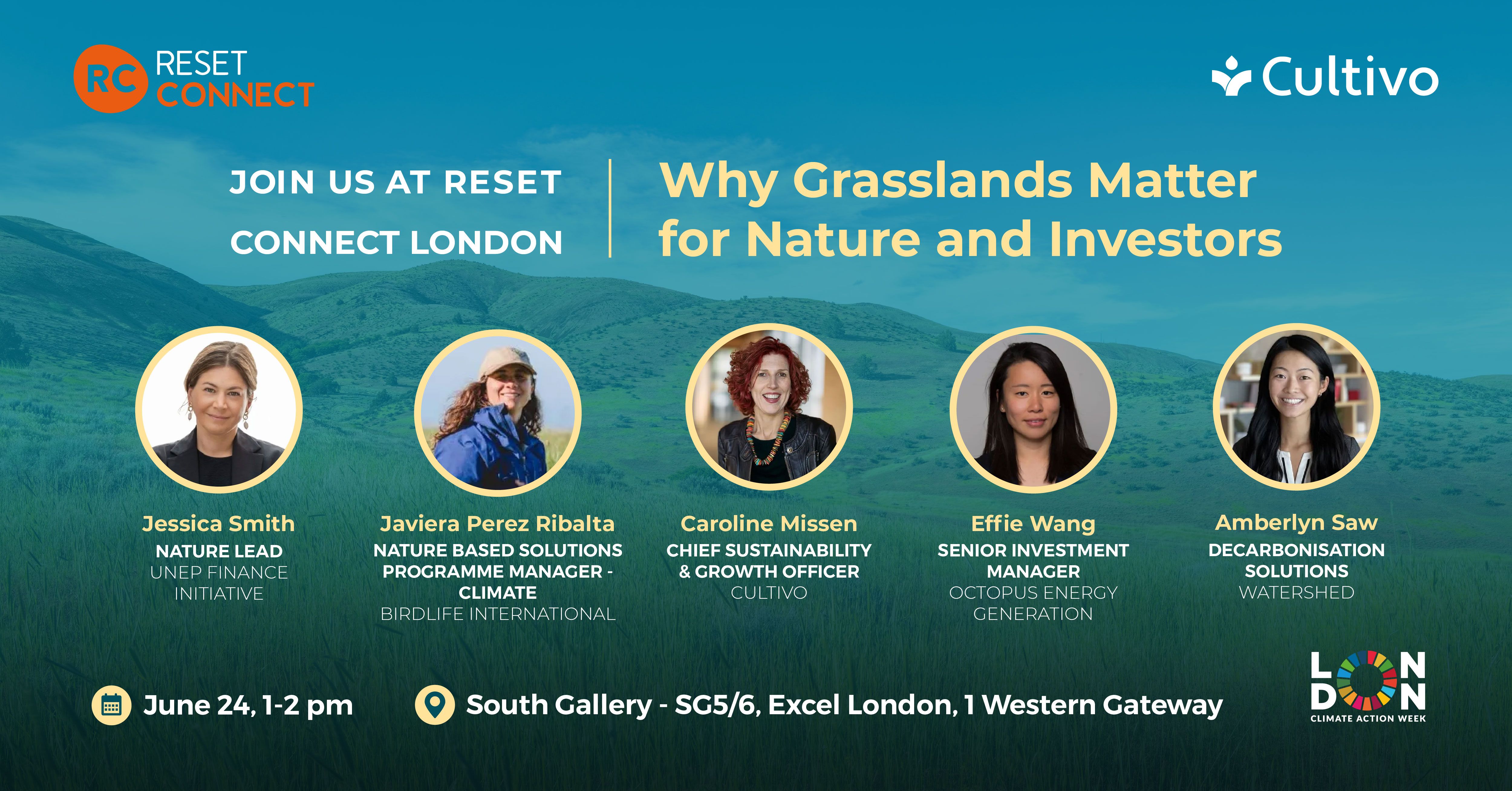
Last month, Cultivo was privileged to co-host a panel on investing in grasslands regeneration at Reset Connect for London Climate Action Week (LCAW).
The panel was entitled “Why Grasslands Matter for Nature and Investors”, and the speakers were our own Chief Growth & Sustainability Officer, Caroline Missen; Javiera Pérez Ribalta, Nature-based Solutions Programme Manager - Climate, BirdLife International; Effie Wang, Senior Investment Manager, Octopus Energy Generation; and Amberlyn Saw, Decarbonisation Solutions, Watershed Technologies. The discussion was moderated by Jessica Smith, Nature Lead, United Nations Environment Programme - Finance Initiative.
Takeaways from both the panel discussion and London Climate Action Week generally focused on nature-based solutions – particularly grasslands regeneration – gaining traction as a vital and financially attractive institutional asset class.
More specific observations included:
- Investment in nature is now mainstream. Nature-based investment was the talk of LCAW, and there was lots of positive feedback and momentum around the topic. Attendees were clearly coming to the realization that the climate crisis can not be addressed without also addressing the threats of biodiversity loss, water scarcity, and land degradation, and that the investment in, and restoration and preservation of natural ecosystems is essential.
- Nature investing is institutional investing. With this focus on investment in nature there is also an increasing awareness of nature as an institutional asset class and financial opportunity, both from the perspective of infrastructure investment and venture capital.
- Grasslands are coming to be understood as an attractive opportunity for investors and offtakers; but more work needs to be done to raise visibility. Grasslands make up 40 percent of the Earth’s land area and store 30 percent of the world's terrestrial stock of carbon. Grasslands are global, existing everywhere from the Great Plains of North America, to the Pampas in South America, to Sub-Saharan Africa, to the steppe of Central Asia. For this reason and others, they represent a scalable institutional portfolio diversifier.
- Grasslands as a form of nature-based CDR can help companies get on track to reach their 2030 goals. Sustainable Grasslands Management as a project type can be less capital intensive than tree-based projects, and also have a more linear profile in terms of how carbon is sequestered over time.That can mean a shorter credit issuance timeframe, and a correspondingly shorter timeline to achieving targeted returns on investment. It can also present near-term opportunities for companies questioning how to reach their 2030 climate and nature goals.
- Grasslands offer numerous benefits in addition to carbon removal. These include ecosystem regeneration – supporting habitat restoration for birdlife, pollinators and mammals – improved water resilience, fire and flood protection, job creation, and enhanced community health. A healthy grassland is able to retain water, support natural aquifers, and sustain healthy water cycling. Healthy soil and the prevention of soil erosion also supports increased forage for livestock and enhanced pasture productivity.

- It takes an ecosystem to build an ecosystem. At Cultivo we work especially hard to bring together multiple stakeholders. These include landowners, which could mean private landowners, multi-generational families, indigenous communities, governments, NGOs, investors, offtakers, and other project partners. We’re also diligent about exploring how we can unlock investment at scale with private capital. Sometimes that requires a blended finance approach with early stage philanthropic organizations, or an investment of catalytic capital to support a project progressing to an investable stage.
- Ranchers and farmers significantly benefit from investment in grasslands. Many ranchers and farmers around the world have marginal businesses - asset rich but cash poor. Having a long-term additional revenue stream and access to capital for infrastructure investment provides a significant advantage. Ranchers can face a serious trade-off if they don't have enough resources to continue their activities. Shortfalls may necessitate supplemental employment, or lead to making other short-term decisions that do not support sustainable land management, exacerbating land degradation.
- Off-takers are looking for high quality carbon credits. Buyers of credits are increasingly looking for projects that are designed and executed to a very high quality and provide permanence and additionality. Providing data transparency and proving robust baselining can provide additional assurance. Cultivo uses remote sensing data for rapid insight into natural capital potential, complemented with ground truth data collected by in-the-field experts.
- We don’t need to pit project types against one another. In particular, it’s not a choice between forests and grasslands, nature or engineered solutions.; all carbon removal solutions have merit and can co-exist. We need to invest in multiple approaches to mitigate the global temperature rise above 1.5 degrees, to prevent the further loss of nature and biodiversity, and to regenerate degraded ecosystems around the world.
- More effort is needed. More needs to be done to raise the visibility of grasslands regeneration as an essential solution for the climate and biodiversity crises, and an attractive investment opportunity for investors and offtakers.
You can learn more about the crucial ecosystem services provided by grasslands and the value of investing in their regeneration on our Unlocking the value of grasslands page of our website.